
Organizational corruption and wrongdoing sit at the heart of climate, health, democracy, and the other grand challenges of our time. Glencore, Samsung, Siemens, Volkswagen, Binance. The names change, but the story keeps repeating. Decades of research, laws, and compliance programs have not eliminated organizational corruption.
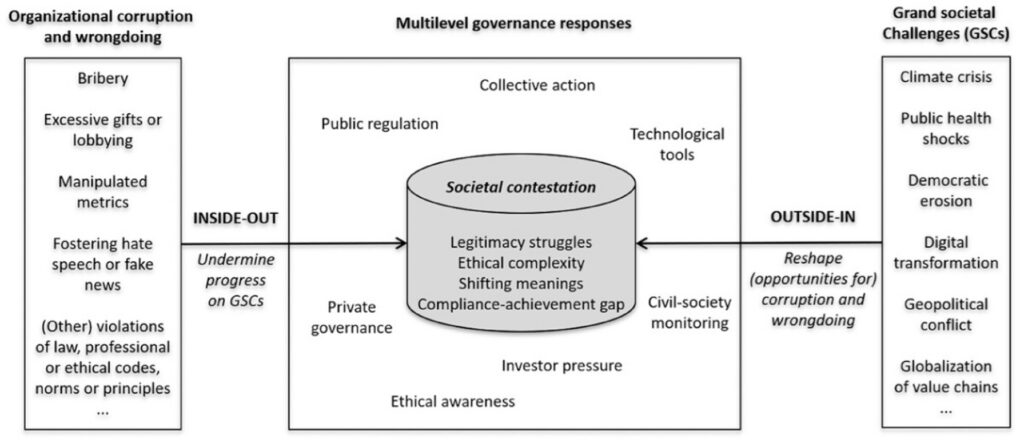
That persistence is the starting point for a Special Issue of Business & Society on corruption and wrongdoing, which we (Stefan Schembera, Armando Castro, Don Lange, Kathleen Rehbein, and I) had the privilege of co-editing. In our open-access introduction (link in comments) to the Business & Society Special Issue, we examine the two-way street between corporate misconduct and grand societal challenges:
Inside-Out Effect: Corruption inside companies (e.g., manipulated emissions, bribery, excessive lobbying) directly undermines progress on climate action, public health, and human rights.
Outside-In Effect: Crises and emerging sectors create urgency, financial flows, and regulatory gaps that spark new avenues for fraud and misconduct (e.g., COVID-19 mask scams, crypto fraud).
Governance cuts across both. But reforms can quietly unravel once outside pressure fades. Beyond Bribery, modern organizational wrongdoing spans gray areas such as manipulated ESG metrics, tax evasion, greenwashing, and supply chain abuses.
Source: https://journals.sagepub.com/doi/epub/10.1177/00076503261490684
Key takeaways for business leaders, boards, and regulators:
- Treat corruption as a core strategic and societal risk, not just a narrow legal issue.
- Scrutinize ESG claims: Look past surface disclosures to verify whether internal policies actually change behavior or merely polish appearances.
- Build crisis-resilient governance: Ensure oversight and procurement rules remain robust during rapid market shifts and high-uncertainty events.
- Integrate anti-corruption into all SDGs: Anti-corruption isn’t an isolated goal—it is a prerequisite for tackling climate, health, and economic stability.
Corruption is not a side issue. It determines whether our collective responses to world challenges succeed or fail. More on the special issue and the studies it includes to follow

Leave a Reply